
Learning to See Through the Eyes of Christ
The Holy Spirit makes Christ beautiful to us. As His beauty captures our hearts, it begins to reorder what we see, what we hear and how we live.
Something remarkable happens as Christ becomes more precious to us: the things that once captivated us begin to loosen their grip. Our attention changes. Our desires change. Even the way we use our time begins to change.
Whether we are reading a book, listening to music, responding to world events, serving others or noticing those who are overlooked, our hearts begin to turn towards Jesus. We seek Him, long for Him and grow in love for Him. Slowly and quietly, His life begins to shape our own.
This is not obedience as a call of duty. It is not religious effort undertaken under duress. It is a willing response to beauty — a movement of the heart that feels less like striving and more like coming home.
It is a gift. It can only be grace.
Success no longer needs to save us, because we have come to know the one true Saviour. The need for approval, achievement and control begins to lessen. Amid the many voices calling us towards the broad road, we begin to hear another invitation: the narrow way of Jesus.
How do we receive such a gift? How does Christ become increasingly beautiful to us, and how does that beauty transform the way we see the world?
Let us explore this together.
Two people, two worlds
Two people can stand in the same place and see two different worlds.
One sees the traffic, the delay and another Monday morning to endure. The other, sitting in the car behind, sees the same congestion but notices the light spilling over the hills and is reminded of God. Almost without meaning to, they give thanks.
One meets a difficult colleague, sees an obstacle and wishes to be somewhere else. Another sees a person who may be carrying something heavier than they allow anyone to know and chooses, for now, to remain present.
One looks in the mirror and sees age, failure and everything they wish were different. Another is slowly learning to see someone known by God, held by grace and deeply loved.
Nothing before them has changed. What has changed is the way they see.
There is a beautiful simplicity to the invitation of Jesus: Follow me. Yet following Him is not simply a matter of learning new beliefs, becoming more religious or adopting a better moral code. It is allowing Him to make us into different people. And that transformation often begins when He changes what we are able to see. Before our direction changes, our vision must change. Before we can walk faithfully, we must begin to recognise the Kingdom into which He is leading us.
An awakening of sight
Jesus’ ministry was concerned not only with changing what people did, but with opening their eyes to realities they had failed to recognise. He restored physical sight, but He also challenged spiritual blindness. He taught people to look again: at God, at themselves, at their neighbours and at the world around them.
Paul prayed that the eyes of your heart would be enlightened, so that believers might know the hope to which God had called them (Ephesians 1:18). The Christian journey is, in part, an awakening of sight. We begin to recognise what was always present but had been obscured by fear, pride, hurry or the values through which the world has taught us to interpret life.
The Kingdom that overturns what we admire
We could read the Sermon on the Mount as a list of instructions for becoming a better person, or perhaps a good person — a higher standard that sincere Christians must somehow reach. Yet before Jesus asks His listeners to live differently, He invites them to see differently. He reveals a Kingdom that radically overturns everything they have been taught to admire, desire and pursue.
It would have sounded strange by the standards of any age, and perhaps more astonishing still to those gathered on the sunlit grass of a Galilean hillside, the Sea of Galilee stretching below them, as Jesus overturned everything their world had taught them to call blessed.
Jesus began:
“Blessed are the poor in spirit, for the kingdom of heaven belongs to them.”
Matthew 5:3, NET
He went on to call those who mourn blessed, the meek blessed, the merciful blessed, the pure in heart blessed and the peacemakers blessed. He pronounced blessing upon those persecuted for righteousness. These were not the people the world naturally envied or celebrated. Yet Jesus placed them at the centre of His Kingdom.
He was not simply offering a more demanding moral code. He was revealing that God sees differently. The qualities the world dismisses as weakness may be precious in the sight of God, while the things we often mistake for blessing — status, power, comfort and self-sufficiency — may leave us unable to recognise how deeply we need Him.
Jesus was not romanticising grief, poverty or persecution. Nor was He suggesting that suffering is good in itself. He was revealing that the world’s measurements are not God’s measurements. Those whom society overlooks are not invisible to the Father. Those who recognise their spiritual need may be nearer to the Kingdom than those who appear self-sufficient. Mercy may possess a strength the world cannot recognise, and meekness may contain a beauty that power cannot imitate.
This was not simply a new set of values. It was a new way of seeing.
The world begins teaching us early what to look for. More is better. Achievement proves worth. Security comes from control. Beauty gains approval. Love must be earned. Inheritance belongs to the right bloodline. These messages become so deeply ingrained that we stop hearing them as beliefs. They become the lenses through which we interpret everything.
Through those lenses, success looks like being ahead of others. Strength looks like never needing help. Beauty looks like meeting an outward standard. Freedom looks like having complete control over our lives. Even goodness can become another form of striving, as though we might finally become worthy of God’s affection if only we perform well enough.
The narrow gate
By the end of the Sermon on the Mount, Jesus places a choice before us:
“Enter through the narrow gate, because the gate is wide and the way is spacious that leads to destruction, and there are many who enter through it. But the gate is narrow and the way is difficult that leads to life, and there are few who find it.”
Matthew 7:13–14, NET
The broad way is easy to enter because it agrees with what is already believed. It tells us that life is found through gaining more, securing more, proving more and becoming more. It can even persuade us that life with God is found by being good enough and doing enough good. It rarely asks whether the things we pursue are capable of carrying the weight we place upon them.
The narrow gate begins somewhere stranger. It begins with the possibility that Jesus sees reality more clearly than we do.
What if life is found not through grasping, but through letting go?
What if greatness is not found in being served, but in serving?
What if freedom is not complete control, but trust in Him?
What if what looks like loss can become the beginning of life?
Why the narrow way feels like loss
But we resist it. The narrow way can feel unnatural, even contrary to our instinct for self-preservation. It is the experience of a cat being placed into a carrier: frightened, suspicious and resisting with every part of its body, unable to understand that the journey it fears is actually an act of love and care.
St John of the Cross understood this paradox of the narrow way. In The Ascent of Mount Carmel, he writes:
To come to enjoy what you have not,
you must go by a way in which you enjoy not.
To come to the knowledge you have not,
you must go by a way in which you know not.
To come to the possession you have not,
you must go by a way in which you possess not.
To come to be what you are not,
you must go by a way in which you are not.
The way of Christ can feel disorienting because it asks us to release the very things upon which we have relied: our familiar pleasures, our understanding, our possessions and even the identity we have constructed for ourselves. We resist because surrender can feel like loss. Yet Jesus is not leading us into emptiness for its own sake. He is freeing our hands to receive a life we could never secure through grasping.
Jesus is radical. His way can feel as though it turns our whole world upside down. Yet stay with His teaching long enough and we begin to see that He is not overturning reality at all. He is turning our distorted vision the right way up.
We are beautiful because we are loved
Nowhere is this reversal more tender than in what the gospel reveals about who we are.
Most of us spend a great deal of life trying to become worthy of love. We work harder, achieve more, help more and try to become better, hoping that one day we will finally feel sufficient. We may carry this striving into our relationship with God, quietly believing that His delight rises and falls with our performance.
The gospel begins in the opposite place:
“But God demonstrates his own love for us, in that while we were still sinners, Christ died for us.”
Romans 5:8, NET
God did not wait for us to become good enough to love. Christ came while we were still sinners. His love did not appear as the reward waiting at the end of our transformation. His love is what makes transformation possible.
We are not beautiful in God’s sight because we have proved ourselves good. We are loved because love belongs to His character, and through that love He begins restoring what sin has disordered within us.
We are beautiful because we are loved. There is nothing we can do, change, become, achieve or possess that will make us more precious to Him. And when we begin to receive this grace, our eyes open to beauty in places we had not previously been able to see.
This does not mean God calls evil beautiful or that our choices are unimportant. It means our worth is not manufactured by our goodness. We do not transform ourselves into people God can finally accept. In Christ, we are received by grace, and from that place of acceptance the slow work of renewal begins.
When this truth moves beyond our minds and settles into our hearts, something begins to shift. We stop working quite so desperately to earn what has already been given. We loosen our grip on the goals that promised happiness once we had finally achieved them. Obedience becomes less like a performance offered to gain approval and more like the grateful response of someone who knows they are loved.
Seeing people differently
And so we also begin to see other people differently.
There are fewer interruptions and more neighbours; fewer rivals and more fellow companions who bear His image. We become less willing to reduce people to their worst decisions, their usefulness to us or the ways they disagree with us.
This does not make us naïve about harmful behaviour, nor does it remove the need for discernment, truth and wise boundaries. Jesus saw people with compassion, but He also saw them truthfully. He did not make personal comfort, the absence of conflict or even peaceful relationships the measure of faithfulness. When love required confrontation, He confronted. When truth created tension, He did not retreat. He walked towards and through conflict when necessary, not to defeat people, but to remain faithful to the Father and to call others towards the life of His Kingdom.
He saw Zacchaeus before the crowd saw anything but a corrupt tax collector. He noticed a widow giving two small coins while others were impressed by larger gifts. He welcomed children whom the disciples considered an interruption. He saw hunger, grief, faith and possibility in people others passed by.
To see beautifully is not to pretend everyone is harmless or every circumstance pleasant. It is to refuse to let brokenness become the only thing we can see.
The ordinary opens into something more
Jesus lived with this kind of attention to the ordinary world as well. He looked at birds and saw the Father’s care. He looked at flowers and saw beauty that human splendour could not reproduce. He watched seeds disappear beneath the soil and saw the hidden growth of the Kingdom. He saw lessons in bread, vines, lamps, trees, weather and water.
Wherever Jesus looked, the ordinary opened into something more.
The created world was never merely scenery. It became a testimony to the generosity and sustaining presence of the Father. Jesus did not ask His listeners to escape the physical world to find God. He asked them to look more carefully at what was already before them.
When we stop to see, the moment can interrupt our hurry, hold our attention and invite us to look beyond the immediate visible image towards the truth it represents. The image of the Shepherd points beyond itself to Christ. A gate encountered on a walk across the fields — closed to protect what lies within — can cause us to pause before the invitation of Jesus.
This is also why sacred art can matter. It cannot give us Christ, but it can direct our attention towards Him. It can create a pause in which we behold rather than merely glance, wonder rather than consume, and remember what hurry has made us forget.
Paul writes that, with unveiled faces, believers reflect the glory of the Lord and are being transformed into the same image from one degree of glory to another, through the work of the Spirit (2 Corinthians 3:18, NET).
We look towards Christ, and what we behold begins to reshape us.
His humility confronts our pride. His compassion softens our judgement. His courage challenges our compromises. His mercy loosens our resentment. His sacrificial love teaches us that beauty is not merely found in what attracts pleasant attention, but in what gives itself for the good of another.
The cross: the greatest lesson in sight
And so the cross becomes the greatest lesson in sight.
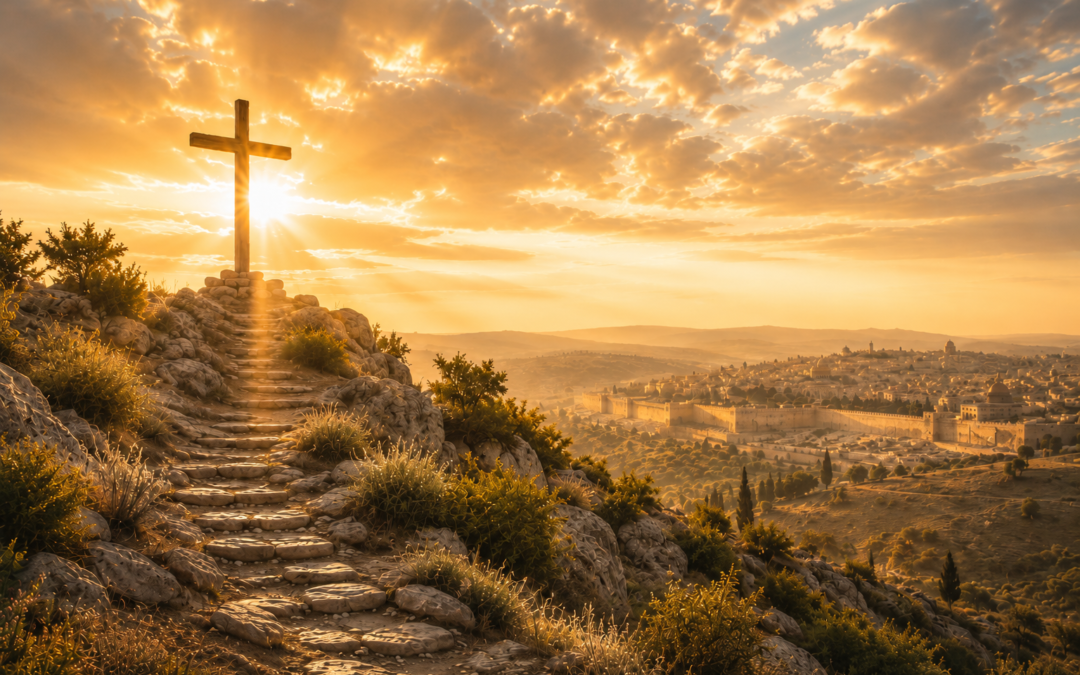
To those standing outside Jerusalem, it looked like defeat: weakness, shame and an ending. Jesus appeared powerless, and His enemies appeared victorious. Yet in that very place, God was reconciling the world to Himself. What looked like loss was becoming salvation; what appeared to be death would open into resurrection. From suffering that seemed beyond comprehension, a beauty beyond explanation was being poured into the world.
The cross does not make cruelty or suffering beautiful. Its beauty lies in the love of Christ, who willingly entered suffering to rescue those who could not rescue themselves.
This is the pattern of the Kingdom. To receive, we first open our hands. To become great, we learn to serve. To find our lives, we surrender the false selves we have struggled to preserve. To become beautiful, we discover that we were loved before we had anything beautiful to offer.
Where seeing becomes discipleship
Seeing beautifully, then, is far more than admiring beautiful things. It is learning to perceive reality through the light of Christ. It is seeing God not as a distant taskmaster, but as the Father who has come near. It is seeing ourselves neither as flawless nor hopeless, but as sinners met by grace and beloved children being renewed. It is seeing others not as idols, enemies or inconveniences, but as people bearing the image of God. It is seeing creation not as something to worship or exploit, but as a gift that points beyond itself to its Creator.
As our seeing changes, our wanting changes too.
The things we once chased begin to loosen their hold. Recognition becomes less important than faithfulness. Control gives way, slowly, to trust. What once appeared ordinary begins to shine with meaning. We discover beauty in humility, mercy, courage, truthfulness and quiet service.
This is where discipleship begins. Not with trying harder, doing more good works or becoming more visibly religious, but with allowing Jesus to lift the old lenses from our eyes and teach us to see as He sees. For the narrow gate is not merely an invitation to walk a different road. It is an invitation to become a different person as we follow Christ along it.
The narrow way, it turns out, is not only the difficult road.
It is the more beautiful one.
And we have only just reached the gate.
A Gentle Invitation
Tomorrow, before the day gathers speed, pause and pray something simple:
Lord Jesus, help me to see today as You see.
Then go about your day and notice. Notice the people you usually hurry past. Notice the light, the landscape and the small mercies. Notice the blossom beneath your feet and how it seems to pave the way before you. Notice your instinctive judgements and the stories you tell yourself about your worth, your time or your lack of money. Notice where Christ may be inviting you to look again.
You may discover that He has been present all along.
It was not His presence that was missing.
It was your eyes beginning to open.
Questions for Reflection
Where have I allowed the world to define success, beauty or significance for me?
In what areas of my life am I still trying to earn what God has already given through His love?
How might my relationships change if I intentionally saw each person as someone deeply loved by God?
What ordinary moments today might become opportunities to notice the beauty and presence of Christ?
What might it look like to choose the narrow way, not simply in my actions, but in the way I see the world?
A Prayer for Seeing Beautifully
Lord Jesus,
Open the eyes of my heart. Help me to see.
I bring before You the ways my vision has been shaped by the values of the world. I know I am drawn towards appearances, achievement, approval and control. I mistake what is impressive for what is beautiful, and I overlook the quiet places where Your Kingdom is already at work.
Teach me to see You more clearly. Show me how.
Help me behold Your beauty in Scripture: Your humility, holiness, compassion, courage and sacrificial love. By Your Holy Spirit, make the truth of the gospel real within me, so that I do not merely know that I am loved, but learn to live as one who is accepted and adopted in You.
Teach me to see myself truthfully — not as good enough to earn Your favour, nor as too broken to receive it, but as a beloved child being renewed in Your likeness.
Teach me to see others through Your compassion. Free me from idolising those I admire, condemning those I oppose or resenting those who challenge me beyond my comfort. Forgive me for overlooking those who appear unimportant. Remind me that every person bears the image of God.
Awaken me to Your glory in creation and to the signs of Your Kingdom in ordinary life. Let sacred beauty direct my gaze beyond itself towards You.
When the narrow way appears costly, help me see that Your way leads to life. When surrender feels like loss, remind me of the cross and resurrection. Reorder my loves until faithfulness becomes more desirable than recognition and Christ becomes more beautiful to me than everything competing for my heart.
May I see beautifully, listen deeply and walk faithfully with You.
Amen.