

The Way
A Narrow Gate Discernment Practice
A gentle way to turn pain into an invitation, and take one faithful step through the narrow gate.
A NINE-STEP PRACTICE
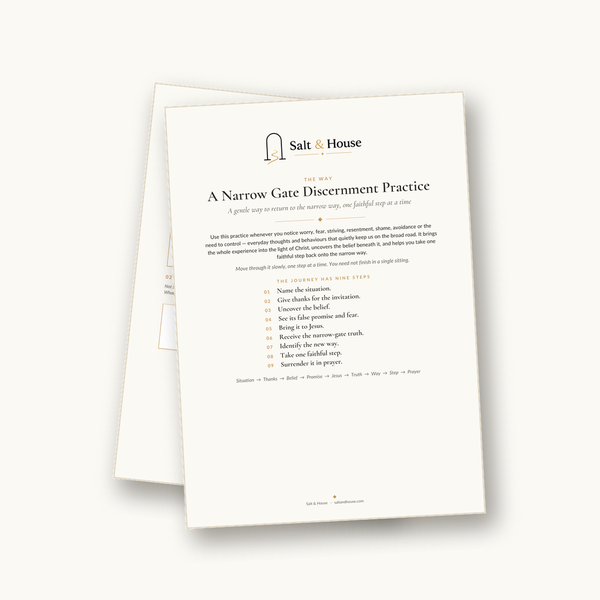
Free printable, fillable PDF with nine reflective steps to move from pain to prayer — with space to write your own responses along the way. Use again and again. No personal details or email required, this is our gift to you.
The Way
Before you begin
Find a quiet moment, and come as you are, honestly and without hurry.
Use this practice whenever you notice worry, fear, striving, resentment, shame, avoidance or the need to control. These are thoughts or behaviours that are not yet aligned with the way of Jesus, and that quietly keep us walking the broad road.
You may not immediately know what belief is shaping your reaction. What you are more likely to notice first is a discomfort, a concern or even pain: something has happened, an emotion keeps returning, or a situation feels as though it has too much power over your peace. It might not feel like discomfort at all. Sometimes what pulls us off the narrow way feels good — the quiet satisfaction of blame, a comforting resentment, a small indulgence — and yet you sense in your heart that it is not the way of Jesus.
The aim is not to deny difficulty or replace every negative thought with a positive one. It is to bring the whole experience into the light of Christ, uncover the belief beneath it, allow Jesus to turn your vision right way up and then take one faithful step.
Move through this slowly, one step at a time. You do not need to complete it in a single sitting. Open each step below when you are ready.
The journey has nine steps
- Name the situation.
- Give thanks for the invitation.
- Uncover the belief.
- See its false promise and fear.
- Bring it to Jesus.
- Receive the narrow-gate truth.
- Identify the new way.
- Take one faithful step.
- Surrender it in prayer.
Situation → Thanks → Belief → Promise → Jesus → Truth → Way → Step → Prayer
01Name what is happening
Begin with the situation itself — plainly, and without judging yourself. Then notice what it stirs in you. A simple way to do this:
The situation is… and it makes me feel…
Separating the two matters, because the situation is rarely the whole story — most of the weight is in what we make it mean.
For example:
The situation is: my life has not turned out how I hoped or expected it to.
And it makes me feel: resentful towards others who have what I want, and generally unhappy with life.
The situation is: I still have debt to repay.
And it makes me feel: trapped, unable to begin the life I want.
The situation is: my manager questioned my work.
And it makes me feel: ashamed, threatened and defensive.
02Give thanks for the invitation
Pause before analysing, reacting or trying to resolve the situation.
Give thanks for the opportunity this moment offers to turn towards Jesus, uncover what is shaping your heart and learn to walk His way.
“Always giving thanks to God the Father for all things in the name of our Lord Jesus Christ.”
Ephesians 5:20
Gratitude does not require us to pretend that everything happening to us is good. It is the decision to recognise that God remains present and good even here.
Ask:
What can I give thanks for in this moment?
Where might grace already be present?
What is this experience revealing that I might otherwise have missed?
How could this become an opportunity to walk more closely with Jesus?
You might pray:
Lord, I would not have chosen this, but I do not pretend to know Your will. I give thanks that You are here with me, and that this moment can become an invitation to know You more deeply. Help me see what is happening within my heart, and learn how to walk Your way. Do not let this moment be wasted. Use it to draw me towards truth, freedom and greater likeness to Christ.
03Uncover the wide-gate belief
Now look beneath the situation and how it makes you feel. Ask:
What does this situation lead me to believe about myself, others or the world?
What does this situation seem to say about me, or what I might be afraid of?
What do I think must change before I believe I can be free, safe, loved or at peace?
The belief may sound like:
I will not be free until I am out of debt.
If my work is not valued, I am not valuable.
Conflict means I am failing or being rejected.
I cannot be at peace until this situation changes.
If I rest, I will fall behind.
If I do not control this, I will be unsafe.
A wide-gate belief often takes this form:
I must gain, achieve, control, avoid, prove or escape something before I can have life.
Or:
Because this has happened, it must mean something condemning about who I am.
Naming the belief helps you recognise that it is a lens through which you are seeing — not necessarily the whole truth.
04See the false promise it makes, and the fear it holds
This step uncovers why the belief has such a grip on us, and why we are reluctant to let it go. A wide-gate belief holds on because it quietly promises something we long for, and warns of something we fear. Naming both — the false promise and the fear — is how its grip begins to loosen.
Ask what the belief is promising you:
What do I believe this achievement, outcome, possession or escape will finally give me?
The answer may be freedom, security, belonging, peace, worth, approval, control or love.
Then ask:
What am I afraid will be true if I do not obtain it?
For example:
If I remain in debt, I will always be trapped.
If I am criticised, I am not good enough.
If someone disagrees with me, I am unsafe or unwanted.
If I rest, I will fail.
If I leave, I may have wasted this season.
If I stay, nothing will ever change.
The belief is not merely an idea. It is attempting to protect a deep longing, or to guard against a deep fear.
05Bring the whole experience before Jesus
Bring the situation, emotion, belief, longing and fear to Christ. Ask:
Jesus, what do You see here?
What does Your life and teaching reveal about this?
What does Scripture say about worth, freedom, security, love or success?
Does this belief lead me towards trust, humility and love — or towards fear, control, condemnation and self-salvation?
What am I asking this situation to give me that only You can securely provide?
Look for the Kingdom reversal.
The world says life comes through gaining. Jesus says we find life through surrender.
The world says greatness comes through status. Jesus says greatness is expressed through service.
The world says security comes through control. Jesus points towards the Father's care.
The world says love must be earned. The gospel says God loved us first.
The world says peace comes when every difficulty is removed. Jesus offers peace within the difficulty.
Do not rush this step. Sit with Scripture. Pray honestly. Invite the Holy Spirit to show you what is true.
06Receive the narrow-gate truth
Do not simply replace the belief with a cheerful opposite. Write a gospel-shaped truth that acknowledges reality without allowing it to define your identity or determine where life is found.
For example:
Situation: I still have debt to repay, and it makes me feel trapped.
Wide-gate belief: I cannot be free until I am debt-free.
Narrow-gate truth: My debt is a real responsibility, but it does not possess my identity. My deepest freedom is already found in Christ, and from that freedom I can repay what I owe faithfully.
Or:
Situation: My life has not turned out the way I hoped, and I feel resentful of others and unhappy with where I am.
Wide-gate belief: A good life is one that matches the picture I had for it — and until mine does, I have been short-changed while others have more.
Narrow-gate truth: My life is not measured against the picture I once held, or against anyone else's. God is present and at work in the life I actually have, and there is grace to receive here, not only in the life I imagined.
Or:
Situation: My work was criticised, and it makes me feel ashamed and unvalued.
Wide-gate belief: If my work is criticised, I am not valuable.
Narrow-gate truth: Feedback may help me grow, but it cannot determine my worth. My work may express my gifts, but my value is already established by God's love.
A helpful sentence pattern is:
This situation is real, but it does not mean __________. I do not need to __________ in order to receive __________. In Christ, I have already received __________, and from that secure place I can __________ faithfully.
The narrow-gate truth does not deny reality. It places reality beneath the greater truth of who God is and who you are in Him.
07Identify the new way
Ask what living from this truth would look like today.
How would I see this situation differently?
How might I respond if I were not trying to prove or protect myself?
What would I stop doing?
What would I begin doing?
What boundary, conversation, act of surrender or decision may be required?
What would love, truth and faithfulness look like here?
The new way might mean working wisely rather than fearfully, receiving feedback without collapsing into shame, resting without treating rest as failure, speaking honestly without needing to win, asking for help instead of hiding, establishing a boundary without hatred, forgiving without denying harm, remaining for this season without believing you are permanently trapped, preparing to leave without treating departure as your salvation, or releasing an outcome you cannot control.
The narrow way is not simply a new thought. It becomes a new way of living.
08Choose one faithful step
Do not demand the whole road. Ask:
What is the next faithful step Jesus may be inviting me to take?
Keep it specific and small enough to practise. For example:
Review my debt plan without condemning myself.
Ask one trusted person to pray with me.
Wait before responding defensively to feedback.
Request clarification rather than assuming rejection.
Have the honest conversation I have been avoiding.
Rest this evening without trying to earn it first.
Read one Gospel passage before checking my phone.
Complete today's task without making its outcome a verdict upon me.
The narrow way is usually walked through repeated acts of faithfulness rather than one dramatic decision.
You do not need the whole map. You need enough light for the next step.
09Surrender it in prayer
Bring the entire process to God.
Lord Jesus, I bring You this situation: __________. It has left me feeling __________.
Even here, I give thanks that You are with me. Thank You that this moment can become an invitation to know You more deeply and learn to walk Your way.
I can see that I have been believing __________. Beneath this belief, I have been longing for __________ and fearing that __________.
Show me what is true. Reveal where fear, shame, control or striving has distorted my vision. Turn my heart and mind right way up.
Help me receive this narrow-gate truth: __________. Remind me that I do not have to earn from the world what You have already given through grace.
Show me the new way of love, truth and faithfulness. Give me the courage to take this next step: __________.
Where I am afraid, teach me to trust. Where I am striving, teach me to receive. Where I am hiding, lead me into truth. Where I am trying to control the whole road, give me enough light for today.
I surrender the outcome to You. Lead me through the narrow gate and form the life of Christ within me. Amen.
The goal is not to persuade yourself that every situation is easy or pleasant. It is to stop allowing a wide-gate belief to determine what is true.
The narrow way begins when the moment we notice becomes an invitation, when the belief beneath it is brought into the light, and Christ is allowed to tell us who we are, where freedom is found and what faithfulness looks like today.
The Way is the original creative property of Salt & House. It may not be reproduced, republished, distributed, adapted or used for commercial purposes, in whole or in part, without prior written permission. You are warmly welcome to print or save it for your own personal, non-commercial devotional use. For any other use, please contact us.
YOUR FREE 7-DAY DEVOTIONAL
The Invitation
Matthew 7:13–14
Jesus doesn’t begin with a list of rules—He begins with an invitation.
The Choice
Deuteronomy 30:15–19
Every day, we are given the choice between life and death.
The Narrow Gate
Luke 13:22–24
The narrow gate is not popular, but it leads to true life.
The Cost
Luke 14:25–33
Following Jesus requires surrender—but the reward is eternal.
The Reward
Matthew 19:29
What we leave behind for Jesus, He multiplies in His Kingdom.
Pick Up Your Cross
Luke 9:23
The daily choice of surrender.
Enter and Walk
John 10:9–10
He leads us in so we can walk in the abundant life He promises.

No spam. May our lives be full, not our inboxes.